Mics
Which mic for which voice
No mic flatters every singer. Three families cover almost every vocal you will track, and each one asks for something different from the room and the engineer.
6 min read
What to remember
- Match the mic to the voice and the room, not to the genre label.
- Dynamic mics are the safe first choice in an untreated space.
- Condensers reveal detail, so they also reveal the room.
- Ribbons reward patience: less gain, more distance, and a quiet source.
Key terms in this guide
- Dynamic mic
- A mic that makes signal with a coil moving inside a magnet. Durable, needs no power, and picks up less of the room. The Shure SM7B and SM58 are dynamic mics.
- Condenser mic
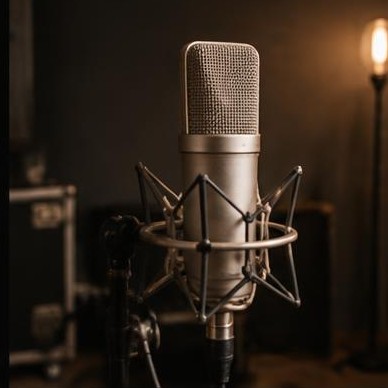
- A mic that uses a thin charged diaphragm next to a metal plate. It captures more detail and high end than a dynamic, and needs power to work.
- Ribbon mic
- A mic that uses a very thin strip of metal suspended in a magnetic field. Smooth and warm sounding, quiet in output, and physically delicate.
- Phantom power (48V)
- A small voltage your interface or preamp sends up the mic cable to power a condenser. Usually a button labeled 48V.
- Proximity effect
- The boost in low end you hear as a singer moves closer to most mics. Closer sounds bigger and bassier; farther sounds thinner and more natural.
- Polar pattern
- The shape of the area a mic listens to. Cardioid, the most common, hears the front and rejects the back.
- Off-axis rejection
- How well a mic ignores sound coming from the sides and back. Good rejection keeps room noise and reflections out of your vocal.
- Sibilance
- Harsh, hissy S and T sounds. Bright condensers can exaggerate it.
- Plosives
- Bursts of air from P and B sounds that thump the mic. A pop filter or a slight angle fixes most of them.
- Gain
- How much your preamp boosts the mic signal. Low-output mics like ribbons and some dynamics need more gain, so a clean preamp matters.
Singers rarely sound better because a mic cost more. They sound better because the mic agrees with the voice, the room, and the part. A breathy folk vocal and a screamed punk vocal can each sound perfect on a $150 dynamic and awful on a vintage tube condenser.
Almost every vocal mic falls into one of three families. Learn what each family asks for and the choice gets short fast.
| Family | Needs power | Sounds best on | Watch out for |
|---|---|---|---|
| Dynamic | None | Loud, forward, or raspy voices; untreated rooms; live use | Dull highs if you push it too hard or too close |
| Condenser | 48V phantom power | Detailed, airy, or delicate vocals in a controlled room | Sibilance, plosives, and every noise in the space |
| Ribbon | None for passive, phantom for active | Warm, smooth vocals, brass, and room mics | Fragile handling, low output, and hard airflow straight on the ribbon |
Start with the room, not the mic
A condenser is a sensitive microphone. It captures the vocal and the space around it, which is a gift in a treated booth and a problem in a spare bedroom with a bare wall behind the singer. If you cannot control the room, a dynamic mic that rejects off-axis sound will save the take, and you can always add air later with a preamp or a gentle high shelf.
The practical test: set the mic up, sing a phrase, and listen for what the room adds. If you hear a boxy reflection, a ringing window, or the air conditioner, treat the space or switch to a tighter mic before you spend money on anything else.
Distance changes the tone more than the model does
Every mic gets bassier as the source moves closer. This is the proximity effect, and it is strongest on dynamics and ribbons. Six inches gives you a natural vocal. Two inches gives you a broadcast voice with a chesty low end, plus more risk of plosives. Two feet gives you the room and a softer, more distant feel.
- Intimate and present: 3 to 6 inches, pop filter on, singer working the mic.
- Natural and honest: 8 to 12 inches, which suits most first sessions.
- Airy and roomy: 18 inches or more, or a ribbon set back and off axis.
Before you buy a mic, move one mic around the room for twenty minutes. You will learn more about your voice than any spec sheet teaches you.
Phantom power, in one paragraph
Condenser mics need 48V phantom power from the interface or preamp, sent down the same XLR cable as the signal. Turn it on with the channel gain down, and never swap a condenser in and out while phantom is live. Passive ribbons are a different story: many tolerate phantom power, but some do not, and a hot-plug can kill one. If you are renting a ribbon, ask the owner whether it wants phantom, and check the cable is wired correctly before you plug in.
A simple way to choose
Untreated room, loud or raspy voice, first session: start dynamic. Treated room, detailed or quiet voice, you want air: start condenser. Harsh or brittle voice, brass, or you want the smooth old-school sound: start ribbon and give it distance.
Why renting beats guessing here
The honest answer about mics is that you find out by using one for a week on real material. Rent an SM7B for one session and a condenser for the next, then compare the raw takes. That is far cheaper than buying three mics on the strength of demos, and it is the fastest way to learn what your own voice actually wants.
Put it to use
Try it before you buy it
Rent the gear for a session instead of guessing. GEARLOVE members rent stage and studio gear from fellow musicians.