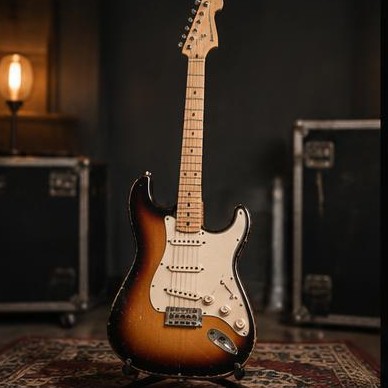
Vintage
What a serial number tells you
A serial number is a factory record, not a certificate. It can narrow down when and where a guitar was built, and it can tell you almost nothing about whether the guitar is what the listing says it is.
6 min read
What to remember
- Serials usually encode date and factory, rarely the model.
- The model name lives on the headstock, the neck stamp, or the label, not in the serial.
- Cross-check pot codes, neck stamps, and factory documentation before you commit.
- No tool, including ours, can prove authenticity from a number alone.
Key terms in this guide
- Serial number
- An ID stamped, printed, or applied by the maker. It often points to a production period or factory, but rarely a specific model.
- Pot code
- A date code stamped on a potentiometer (the volume and tone controls). It shows when the part was made, which helps date an instrument but does not prove the instrument is original.
- Potentiometer (pot)
- The variable resistor behind each volume or tone knob.
- Neck stamp
- A date or code written or stamped on the heel of a bolt-on neck, visible when the neck is removed.
- Neck heel
- The end of the neck where it joins the body.
- Ink stamp vs. impressed stamp
- Ink stamps are printed on the surface. Impressed stamps are pressed into the wood. Makers used different methods in different eras.
- Decal
- A printed transfer, such as a headstock logo or a serial number sticker, applied to the finish.
- Transition era
- A period when a maker changed numbering systems, factories, or specs. Serials from these years can overlap or be ambiguous.
- Provenance
- The documented history of an instrument: receipts, past owners, photos, and letters. Strong provenance supports a story but is separate from authentication.
- Authentication
- A judgment by a qualified expert, often in person, that an instrument and its parts are what they claim to be. A serial lookup is not authentication.
The most common question we hear about a used guitar is what the serial number proves. The honest answer is less dramatic than people hope: it is a production record, and it is one data point among several.
What a serial can tell you
- Rough year or a range of years, once you know the brand's numbering scheme.
- Country or factory, on brands that encode the plant in a prefix or suffix.
- Build order within a run, which is useful when you are comparing two similar instruments.
What it cannot tell you
- The model. Serials almost never encode model names, and a number cannot tell a Standard from a Custom.
- Original parts. Guitars are serviced, refretted, rewired, and reissued bodies get swapped.
- Authenticity. A correct serial format can be printed on a fake, so a number that decodes cleanly is not proof of anything.
Where the model name actually lives
Gibson: the face of the headstock, the truss rod cover, or the label inside the soundhole or F-hole. Fender: the headstock decal, or the stamp on the neck heel. Martin: the model is stamped just above the serial on the neck block inside the soundhole. In every case the model comes from the markings on the instrument, not from the number.
How the big three number their guitars
- Fender uses letter prefixes that point to a country or plant, then digits that narrow the era. A US prefix means Corona, California; MX points to Mexico; Squier and Japanese imports carry their own prefixes.
- Gibson has changed systems several times. The 8-digit run from 1971 to 1987 is the one most players hit, and it encodes both a date and a factory. Earlier 6-digit numbers and modern 9-digit numbers use different logic.
- Martin numbers track build order, so a serial alone gives you a date range rather than an exact year, and the model sits separately on the neck block.
Our free lookup handles these three schemes and marks everything else Coming soon! It reports the year, era, and factory it can support, and says so plainly when the number only supports a range.
The cross-checks that actually matter
- Pot codes. The date codes on the potentiometers tell you when the parts were made, which puts a floor under the build date. If the pots post-date the claimed year, the guitar has been rewired or the story is wrong.
- Neck stamps and heel marks. On bolt-necks, the stamp usually gives a date or period. Check whether the neck and body dates agree with the story.
- Pickups, pickguard, and hardware. Screws that show heavy wear, holes that do not line up, or a pickguard that does not match the finish all point to modification.
- Factory documentation. Gibson history letters, Martin factory order records, and assembly line documents are the strongest evidence available to a private buyer, and they take weeks or months to obtain.
- Play it and open it up. Fit, fret wear, solder joints, and the smell of the case tell you more about the last forty years than any label does.
Fine print
Pilot reference tool provided for informational convenience only. GEARLOVE does not authenticate, certify, or guarantee the age, provenance, original specifications, or condition of any instrument or equipment. Due diligence and verification remain the sole responsibility of owners and renters. For high-value vintage appraisals or verified authenticity, always cross-reference pot codes, neck stamps, and factory documentation.
If a deal depends on a number being real, spend the money on a history letter or an in-person inspection by a luthier you trust.
Put it to use
Look up your serial
Decode a Gibson, Fender, or Martin serial number and see what the factory record says.